

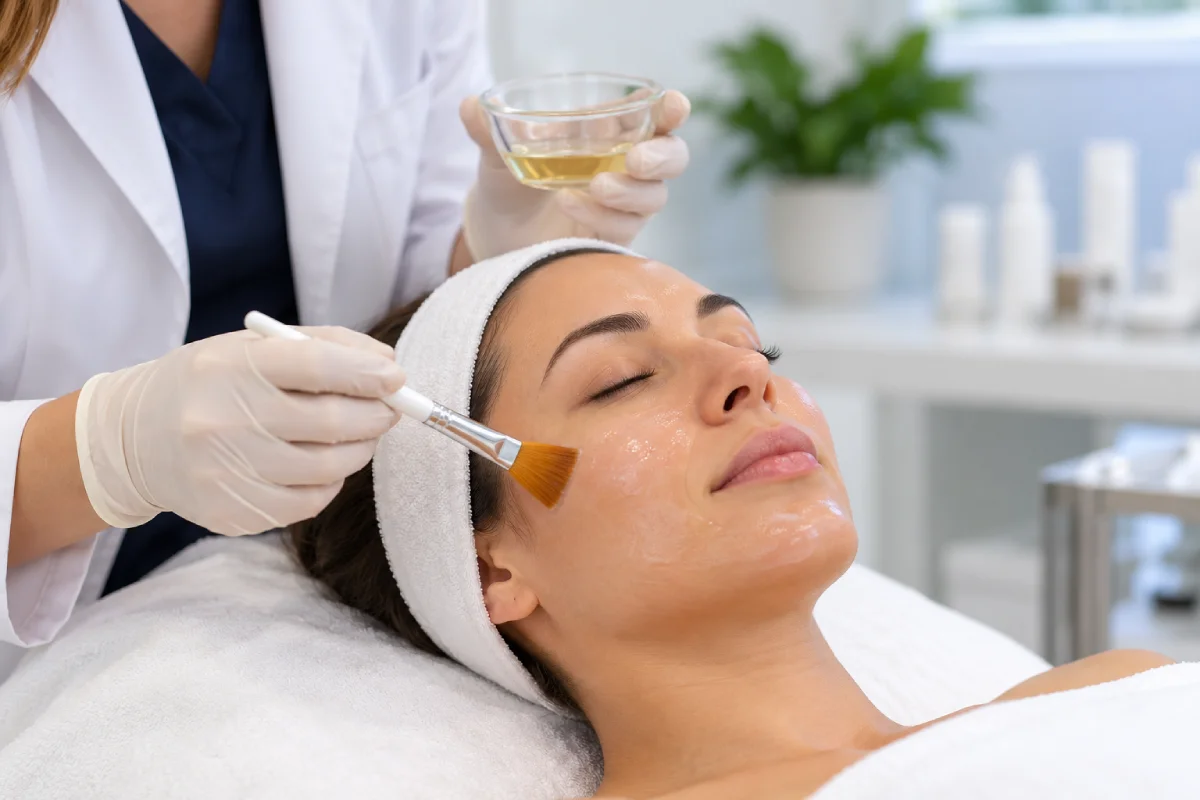
Chemical peel requirements depend on treatment depth, professional licensing, and the laws of the state where a service is performed. A superficial exfoliating treatment may fall within an esthetician’s licensed activities, while a medium or deep peel may be regulated as a medical procedure. Clinics must distinguish cosmetic skin care from procedures that require medical assessment, delegation, or supervision. A medical director for chemical peels may help a practice establish clinical policies, assess staffing roles, and arrange appropriate physician involvement where required. The physician’s title alone does not expand anyone’s scope of practice. Reviewing the proposed peel ingredients, technique, staff qualifications, and state board guidance before offering treatments is essential for operating lawfully and reducing patient risk.
Table of Contents
Key Takeaways: Chemical Peel Oversight at a Glance
- Whether a chemical peel requires a medical director depends on state rules, treatment depth, and the clinician performing it.
- Light superficial peels may be within some estheticians’ scope, but medium and deep peels generally involve greater medical oversight.
- Physician involvement does not give an esthetician or nurse permission to perform procedures outside their legal scope.
- Written screening, consent, complication-response, and referral processes support safer peel services.
- Clinics should verify licensing, delegation, ownership, and medical-director duties before adding stronger treatments.
1. When Does a Chemical Peel Become a Medical Procedure?
Chemical peel regulations focus on what the treatment does to the skin, not simply the name on a service menu. Peels use acidic or other exfoliating agents to remove varying layers of skin. Their effects depend on the formulation, concentration, application method, exposure time, preparation of the skin, and patient characteristics. A service described as a “light peel” can still warrant careful review if its technique or product creates a deeper injury than intended.
Superficial peels generally target the outermost layers of skin. Some states allow appropriately trained estheticians to perform certain superficial exfoliation services within their cosmetology license. Medium and deep peels affect living tissue more substantially and commonly enter the territory of medical treatment. For example, Texas distinguishes noninvasive superficial peels from medium and deep peels that penetrate the dermis, treating the latter as medical procedures.
There is no reliable nationwide rule that every chemical peel either requires or does not require a medical director. Clinic operators must examine the actual procedure and consult the relevant licensing boards. State guidance, staff credentials, and physician delegation rules take priority over how a product supplier categorizes the service.
How Do Superficial, Medium, and Deep Peels Differ?
Superficial chemical peels generally work in outer skin layers and are often used for cosmetic exfoliation. Medium-depth peels reach deeper skin structures, while deep peels produce more extensive tissue injury and require more intensive clinical assessment and follow-up. These broad categories help describe treatment intensity, but the label alone cannot determine whether a particular staff member may perform the procedure.
A peel’s actual depth depends on more than the acid name. Product strength, skin preparation, number of passes, application time, and patient skin characteristics can change the response. A high-strength product used without appropriate assessment may cause burns or scarring even when the provider expects a mild effect.
Before adding a treatment, practices should document its manufacturer instructions, intended depth, indications, contraindications, personnel requirements, and emergency plan. They should then compare those characteristics against applicable state cosmetology, nursing, and medical board rules. Where state guidance is unclear, obtain advice from a qualified healthcare attorney and the relevant board before marketing the service. Training certificates are useful evidence of instruction, but they are not substitutes for state professional licensure.
2. Which Professionals May Perform Chemical Peels?
Chemical peel provider eligibility depends on the practitioner’s license, authorized scope, state law, and the kind of peel being offered. Estheticians may perform some cosmetic exfoliation procedures in certain jurisdictions. Registered nurses may perform particular treatments under valid medical orders and professional standards, but their scope varies by state and setting. Advanced practice nurses and physician assistants may have different clinical authority, including requirements for physician involvement where applicable.
A clinic should not treat all licensed healthcare personnel as interchangeable. Being trained to apply a product does not establish authority to diagnose a medical condition, prescribe medication, or perform a procedure involving deeper tissue injury. The permitted clinical role must be established before the treatment is assigned.
A medical director can review procedures, develop clinical policies, and carry out lawful supervision or delegation when required. That arrangement cannot convert a cosmetology license into a medical license or override statutory restrictions. Clinic owners should record the legal basis for who evaluates patients, who selects the treatment, who applies the peel, and who manages complications.
Clear assignment of these responsibilities makes it easier to build a lawful staffing model and to respond appropriately if the treatment plan must change.
Can an Esthetician Perform a Peel Under a Physician’s Supervision?
An esthetician working under physician supervision may still perform only those activities allowed by the applicable laws and regulations. Some states permit superficial chemical peels under an esthetics license but restrict medium or deep peels to medical professionals or to particular delegated arrangements. A supervising physician cannot authorize an otherwise prohibited procedure simply by signing an agreement.
For a med spa employing estheticians, the appropriate first step is to classify each proposed service. Review the intended depth, the ingredients and concentration, whether the procedure affects living tissue, and the legal scope of the person applying it. A state cosmetology board may regulate superficial services while a medical board governs more invasive treatments.
Estheticians can still play a meaningful role in a compliant clinic by performing authorized services, gathering non-diagnostic intake information, providing permitted aftercare instructions, and identifying concerns that require referral. The medical professional responsible for patient assessment, orders, and complications should be identified separately. Written job descriptions and protocols help prevent staff from assuming that a physician’s presence grants additional powers not provided by their license.
3. What State Rules Should a Med Spa Check First?
Medical director requirements for chemical peels begin with the state rules governing the clinic’s procedures and workforce. Practices should check the cosmetology or esthetics board for allowable superficial treatments and the medical board for procedures classified as medical practice. Nursing and physician assistant board guidance may also be relevant when these professionals deliver services.
Texas offers an illustrative distinction: its licensing department describes non-aggressive superficial peels as potentially within an esthetician’s scope, while medium and deep peels penetrating the dermis are regulated by the state medical board. Other jurisdictions may apply different definitions, product restrictions, or delegation conditions. The Texas distinction therefore should not be copied into policies for another state.
Business structure deserves separate attention. Some states regulate ownership of medical practices, use of physician professional entities, patient evaluation requirements, or financial arrangements with nonphysician operators. Simply paying a physician to serve as a medical director does not automatically make a med spa ownership structure or clinical workflow lawful.
A pre-launch legal and clinical review should identify the regulators involved, the permissible staff roles, the required level of oversight, and any recordkeeping obligations. Reassess that review before expanding to stronger peels or new locations.
Is a Medical Director Required for Every Med Spa Chemical Peel?
A medical director is not automatically required for every chemical peel offered in every state. A business performing only esthetic services that are authorized under its staff’s professional licenses may face different requirements from a practice performing medical-grade peels. A medical director can be necessary for certain medical services, but the applicable law determines whether one is needed and what authority the physician must exercise.
The question cannot be answered by relying on a supplier’s “professional use” label or by assuming all acids at a certain percentage are regulated identically. Technique, penetration, state-specific definitions, and the provider’s license all matter. The medical-director role may also overlap with requirements for medical ownership, prescribing, delegation, or physician assessment, each of which warrants its own examination.
Businesses should maintain a procedure inventory listing each peel and its indications, ingredients, intended depth, personnel, and supervision model. This inventory can support a regulatory review before the service goes live. When uncertain, a practice should pause the proposed procedure until its scope and oversight arrangements are confirmed by appropriate qualified advisors.
4. What Does a Medical Director Actually Oversee?
A medical director for chemical peels may provide clinical leadership by reviewing treatment criteria, identifying higher-risk procedures, and establishing how licensed staff seek medical guidance. Depending on applicable law and the agreed role, the physician may assess patients, authorize treatments, create protocols, train staff, review complications, or provide direct supervision. A contract should distinguish these duties rather than relying on the title alone.
Patient selection is an important part of peel safety. A clinical protocol should address factors that can affect treatment choice and healing, including medication history, relevant skin conditions, previous reactions, recent procedures, and the possibility of altered pigmentation or scarring. It should also identify when the patient requires evaluation by a qualified medical professional rather than a cosmetic consultation.
The FDA has warned that certain high-concentration chemical peel products can cause serious skin injuries when used without appropriate professional oversight. Burns, swelling, infections, color changes, and scarring are foreseeable concerns that make careful product selection and escalation procedures necessary.
The physician’s responsibilities should be proportionate to the clinic’s procedures, personnel, and patient risk, with a documented process for handling questions and treatment-related events.
Which Safety Protocols Should Be Written Before Offering Peels?
Chemical peel safety protocols should identify who is authorized to evaluate, recommend, apply, and monitor each treatment. Patient intake should address contraindications and explain when clinical evaluation is required. Informed consent should cover realistic benefits, alternatives, aftercare, and potential harms, including burns, pigmentation changes, and scarring.
Operational policies should also establish product storage, preparation, application technique, stopping criteria, post-treatment instructions, documentation, and adverse-event escalation. The protocol should name the medical professional responsible for addressing suspected complications and describe how staff obtain timely assistance or arrange urgent care. Any clinical orders or prescriptions must come from an authorized practitioner.
A written protocol is not proof of compliance by itself. Staff must be trained for their lawful assigned tasks, competency should be checked, and the process should reflect current product information and professional requirements. Periodic reviews can identify whether new peels, revised formulations, or changes to staff roles call for different supervision. Records of training, protocol approval, and incident response provide a practical basis for routine quality reviews.
5. How Should Clinics Choose a Medical Director for Chemical Peels?
Choosing a medical director for chemical peels requires assessing the physician’s license, relevant clinical experience, scope of proposed duties, and ability to provide appropriate oversight. A physician who understands skin treatments and complication management may be more suitable for an aesthetic practice than someone without relevant procedural experience. That experience should be verified instead of presumed from a professional title.
Clinic owners should describe their actual peel menu before requesting a service agreement. The physician can then determine whether the treatments fit their competence, how medical evaluations will occur, and which staff can lawfully carry out individual steps. Availability matters as well: procedures that may produce complications need a realistic escalation plan, not an arrangement based solely on a physician’s name appearing on a website.
Contracts should define scope of work, communication expectations, record review, professional liability, fees, termination, and arrangements during physician absence. The clinic should independently confirm state licensing and seek legal advice on ownership, delegation, and business terms when needed.
A medical director relationship works best when the physician’s actual clinical role matches the procedures performed and the practice can demonstrate how oversight takes place.
What Questions Belong in a Medical Director Interview?
Medical director interviews should focus on treatment experience and the practical details of oversight. Begin by asking which peel depths and ingredients the physician has worked with, how they approach patient selection, and how they manage treatment complications. Follow with questions about applicable state rules, staff scope, and the circumstances that require direct physician assessment.
Clinic operators should also ask how protocols are approved and updated, how chart review is handled where required, and who will respond to a time-sensitive concern. Clarify whether the physician is available remotely, in person, or through scheduled sessions, and whether that arrangement satisfies legal and clinical requirements for the practice. An alternative coverage plan may be needed during absences.
Finally, review the written agreement carefully. It should specify duties rather than offer a vague promise of supervision. Confirm what is included in recurring fees, what is billed separately, and how the practice will transition patient care if the relationship ends. These questions reveal whether the physician can provide a workable, lawful structure for the precise chemical peel services the clinic intends to offer.
Conclusion
Chemical peels do not follow one national medical-director rule. Whether physician oversight is required depends on the peel’s depth, the state’s definition of medical practice, the professional license of the person performing the treatment, and any delegation or business-ownership requirements. Superficial esthetic procedures may be treated differently from medium and deep peels, but neither product labels nor a medical director agreement can expand a provider’s authorized scope. Clinics should review state rules, define staff roles, document clinical protocols, and choose a physician whose actual oversight responsibilities match the treatments offered.
Build a Safer, Better-Defined Peel Program
Medical Director Co. helps aesthetic practices connect with physicians for appropriate clinical oversight arrangements. Review your treatment menu and staffing needs before requesting a medical director match.